What are the 5 Nitrogen-Fixing Bacteria
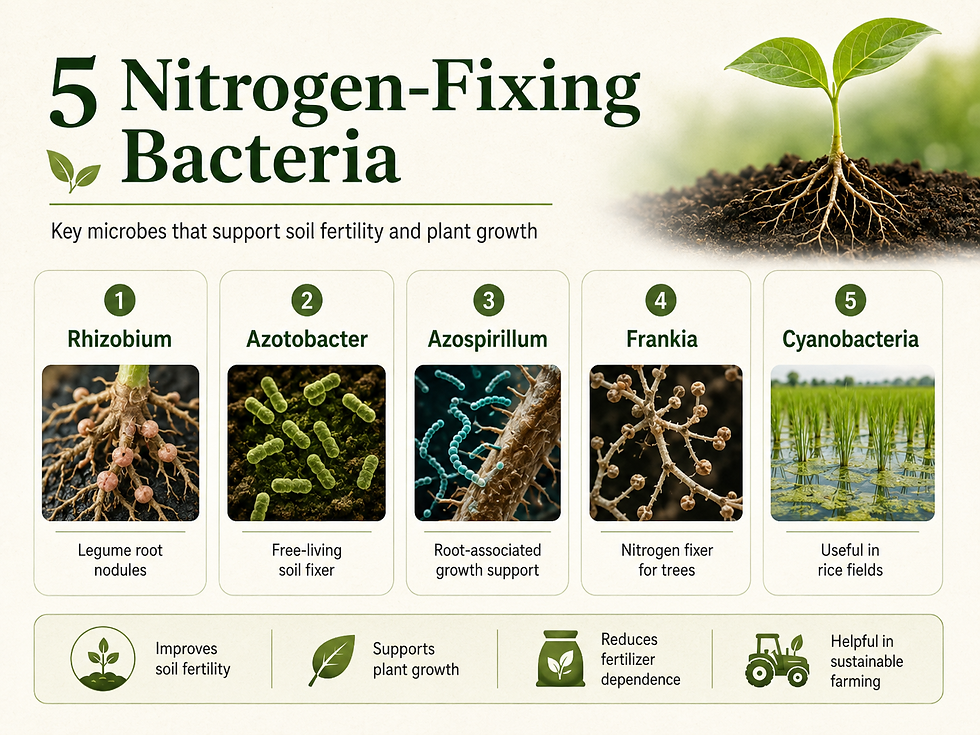
Nitrogen is one of the most essential elements for plant growth, but most of it exists in the atmosphere in an inert form that plants cannot directly use. To make nitrogen available for biological systems, nature depends on a special group of microorganisms known as Nitrogen Fixing Bacteria.
These bacteria convert atmospheric nitrogen (N₂) into ammonia and other usable forms that plants can absorb. This biological process is called biological nitrogen fixation, and it plays a critical role in soil fertility, ecosystem balance, and sustainable agriculture.
Today, these microbes are not only important in natural ecosystems but are also widely used in agriculture, biofertilizers, and soil health management products. Many farmers and agribusinesses now actively search for Nitrogen Fixing Bacteria for sale to improve yield and reduce chemical fertilizer dependency.
Below are the 5 most important nitrogen-fixing bacteria used in nature and agriculture, along with their functions and applications.
1. Rhizobium – The Symbiotic Nitrogen Fixer for Legumes
Rhizobium is one of the most well-known nitrogen-fixing bacteria. It forms a symbiotic relationship with leguminous plants such as peas, beans, chickpeas, and lentils.
How it works:
Rhizobium infects root hairs of legume plants.
It forms specialized structures called root nodules.
Inside these nodules, it converts atmospheric nitrogen into ammonia.
Importance in agriculture:
Improves soil nitrogen content naturally
Reduces need for synthetic nitrogen fertilizers
Enhances crop yield in pulses and legumes
Rhizobium is widely used in biofertilizer formulations because of its efficiency and strong plant compatibility.
2. Azotobacter – Free-Living Nitrogen Fixer
Azotobacter is a free-living nitrogen-fixing bacterium found in soil and rhizosphere regions. Unlike Rhizobium, it does not require a host plant to fix nitrogen.
Key features:
Lives independently in soil
Fixes nitrogen aerobically (requires oxygen)
Produces growth-promoting substances like vitamins and hormones
Agricultural benefits:
Improves soil fertility in non-legume crops
Enhances seed germination and root development
Helps maintain microbial balance in soil
Azotobacter is commonly used in biofertilizer products for cereals, vegetables, and horticultural crops.
3. Azospirillum – Plant Growth Enhancer for Cereal Crops
Azospirillum is another important nitrogen-fixing bacterium associated mainly with non-leguminous plants such as wheat, maize, rice, and sorghum.
Mode of action:
Lives near root surfaces (rhizosphere association)
Fixes nitrogen in close proximity to roots
Produces plant growth hormones like auxins
Benefits:
Improves root length and root branching
Enhances nutrient uptake efficiency
Increases overall crop productivity
Azospirillum is widely used in modern agriculture due to its dual role in nitrogen fixation and plant growth promotion.
4. Frankia – Nitrogen Fixer for Non-Leguminous Trees
Frankia is a unique genus of nitrogen-fixing bacteria that forms symbiotic relationships with non-leguminous plants, especially woody shrubs and trees.
Hosts include:
Alder (Alnus)
Casuarina
Myrica
Elaeagnus
Function:
Forms root nodules similar to Rhizobium
Fixes nitrogen in woody plants
Supports forest ecosystem development
Environmental importance:
Helps in reforestation and land reclamation
Improves soil fertility in degraded lands
Supports ecological succession in poor soils
Frankia plays a key role in natural ecosystems rather than conventional crop farming.
5. Cyanobacteria (Anabaena, Nostoc) – Nitrogen Fixers in Water and Soil
Cyanobacteria are photosynthetic microorganisms capable of fixing nitrogen, especially in aquatic and moist soil environments. Common genera include Anabaena and Nostoc.
Unique characteristics:
Perform photosynthesis like algae
Fix nitrogen in specialized cells called heterocysts
Thrive in water bodies, rice fields, and wetlands
Agricultural role:
Extremely important in paddy (rice) cultivation
Naturally enrich flooded soils with nitrogen
Improve organic matter content in soil
Cyanobacteria are considered eco-friendly biofertilizers for sustainable farming systems.
Importance of Nitrogen Fixing Bacteria in Modern Agriculture
The global demand for food production has increased significantly, and soil health is under continuous pressure due to chemical fertilizer usage. Nitrogen Fixing Bacteria provide a natural and sustainable solution to this challenge.
Key advantages:
Reduce dependence on chemical nitrogen fertilizers
Improve soil microbial diversity
Enhance nutrient cycling in ecosystems
Support organic and sustainable farming practices
Improve long-term soil productivity
These bacteria are now a core component of biofertilizer technology and are widely used in both small-scale farming and large agricultural systems.
Nitrogen Fixing Bacteria for Sale – Industrial and Agricultural Demand
With rising awareness of sustainable agriculture, the demand for Nitrogen Fixing Bacteria for sale has increased globally. Farmers, distributors, and agricultural companies are now actively sourcing high-quality microbial formulations for soil treatment and crop improvement.
These bacteria are typically available in:
Liquid biofertilizers
Powder-based inoculants
Carrier-based microbial formulations
Seed coating treatments
When selecting nitrogen-fixing microbial products, quality, strain efficiency, and viability are critical factors.
For agricultural and industrial buyers, microbial technology providers such as Universal Microbes offer a range of beneficial microbial solutions designed for soil health improvement and plant growth support.
Explore their product range here:Universal Microbes All Products
Applications Across Agriculture and Environment
Nitrogen-fixing bacteria are not limited to crop production. Their applications extend to multiple sectors:
1. Agriculture
Pulse crops (Rhizobium)
Cereals (Azospirillum, Azotobacter)
Rice cultivation (Cyanobacteria)
2. Forestry
Tree plantation improvement (Frankia)
3. Soil Reclamation
Degraded land restoration
Mine soil rehabilitation
4. Organic Farming
Chemical-free nutrient management
Sustainable crop production systems
Why Nitrogen Fixing Bacteria Are the Future of Soil Health
Modern agriculture is shifting toward biological inputs due to environmental concerns and long-term soil degradation caused by excessive chemical fertilizer use.
Nitrogen-fixing microbes provide:
A renewable nitrogen source
Reduced environmental pollution
Better soil structure and microbial activity
Cost-effective farming solutions
This makes them a cornerstone of regenerative agriculture systems worldwide.
The five major Nitrogen Fixing Bacteria—Rhizobium, Azotobacter, Azospirillum, Frankia, and Cyanobacteria—play a critical role in maintaining soil fertility and supporting plant growth naturally.
From agricultural fields to forests and aquatic systems, these microorganisms ensure that nitrogen cycles efficiently through the environment. Their growing commercial availability as Nitrogen Fixing Bacteria for sale reflects their increasing importance in sustainable farming and soil management.
As agriculture moves toward eco-friendly practices, nitrogen-fixing microbes will continue to be essential tools for improving productivity while protecting environmental balance.


Comments