Trichoderma Harzianum a Fungicide or a Biofertilizer
Updated: Jan 27

In modern agriculture, the shift from chemical dependency to biological solutions has changed how farmers and agronomists protect crops and improve yields. One name that frequently appears in this transition is Trichoderma harzianum. It is often described as a fungicide, sometimes as a biofertilizer, and in many cases as both. This creates confusion for growers who want to use it correctly and effectively.
So, what exactly is Trichoderma harzianum? Is it a fungicide, a biofertilizer, or something else entirely? The answer lies in how it works in the soil and around plant roots.
Understanding Trichoderma Harzianum
Trichoderma harzianum is a naturally occurring beneficial fungus found in soil and plant root zones. Unlike harmful fungi that attack crops, this microorganism forms a protective relationship with plants. It colonizes the rhizosphere, the area around plant roots, and actively supports plant health.
Its popularity in sustainable farming comes from its ability to control soil-borne pathogens while also stimulating plant growth. This dual action places it in a unique category that goes beyond traditional agricultural inputs.
Why Trichoderma Harzianum Is Often Called a Fungicide
Trichoderma harzianum is widely recognized for its ability to suppress harmful fungi. Because of this, many growers refer to it as a biological fungicide. However, it does not behave like a chemical fungicide.
How it controls plant diseases
Trichoderma harzianum protects crops through several natural mechanisms:
It competes with harmful fungi for space and nutrients in the soil
It parasitizes pathogenic fungi by breaking down their cell walls
It produces enzymes that inhibit disease-causing organisms
It triggers the plant’s own defense responses
These actions help manage diseases such as root rot, damping-off, wilt, and other soil-borne infections. Instead of killing pathogens instantly, it reduces their population gradually and restores microbial balance in the soil.
This is why Trichoderma harzianum is classified as a biological control agent rather than a conventional fungicide.
Why Trichoderma Harzianum Is Not a Chemical Fungicide
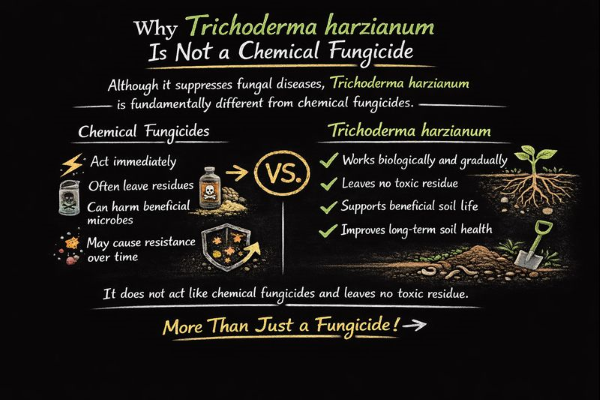
Although it suppresses fungal diseases, Trichoderma harzianum is fundamentally different from chemical fungicides.
Chemical fungicides:
Act immediately
Often leave residues
Can harm beneficial microbes
May cause resistance over time
Trichoderma harzianum:
Works biologically and gradually
Leaves no toxic residue
Supports beneficial soil life
Improves long-term soil health
This distinction is important. Calling it simply a fungicide does not fully describe its role in plant and soil systems.
Is Trichoderma Harzianum a Biofertilizer?
Trichoderma harzianum is not a nutrient fertilizer in the traditional sense. It does not directly supply nitrogen, phosphorus, or potassium. However, it plays a critical role in improving how plants access and use nutrients already present in the soil.
Because of this function, it is commonly included in biofertilizer and biostimulant formulations.
How it supports plant nutrition
Trichoderma harzianum enhances plant growth by:
Improving root development and root branching
Increasing nutrient uptake efficiency
Solubilizing nutrients bound in the soil
Enhancing microbial activity around roots
Stronger roots mean better absorption of water and nutrients, which directly translates into healthier and more resilient plants.
This growth-promoting effect is why Trichoderma harzianum is widely used in biofertilizer programs.
The Role of Trichoderma Harzianum as a Biostimulant
Beyond disease control and nutrient efficiency, Trichoderma harzianum also functions as a plant growth promoter. It stimulates physiological processes inside the plant that support overall development.
Key benefits include:
Faster seed germination
Stronger early plant establishment
Improved tolerance to drought and stress
Enhanced flowering and yield potential
These effects place Trichoderma harzianum in the biostimulant category, making it more than just a protective agent.
Fungicide or Biofertilizer: The Correct Classification
The most accurate way to describe Trichoderma harzianum is:
It functions primarily as a biological control agent and plant growth promoter, and is often included in biofertilizer and biostimulant formulations.
It is not a chemical fungicide.It is not a direct nutrient fertilizer.
Instead, it acts as a living microbial solution that improves plant health from the soil upward.
Applications of Trichoderma Harzianum in Agriculture
Trichoderma harzianum is used across multiple crops and farming systems.
Common application methods
Seed treatment to protect seedlings
Soil application to control root diseases
Drip irrigation for root zone colonization
Nursery and transplant treatments
It is suitable for cereals, vegetables, fruits, pulses, oilseeds, and horticultural crops.
Compatibility with Other Agricultural Inputs
One of the strengths of Trichoderma harzianum is its compatibility with sustainable farming practices.
Works well with organic inputs
Can be combined with many biofertilizers
Suitable for integrated pest management programs
However, it should not be mixed directly with strong chemical fungicides, as they may reduce its effectiveness. Benefits for Long-Term Soil Health
Regular use of Trichoderma harzianum contributes to long-term improvements in soil quality.
Maintains microbial diversity
Reduces pathogen pressure over time
Improves soil structure indirectly
Supports sustainable yield stability
This makes it especially valuable for farmers aiming to reduce chemical dependency.
Why Farmers Prefer Trichoderma harzianum Today
The increasing adoption of Trichoderma harzianum is driven by practical results rather than theory.
Farmers choose it because:
It reduces crop losses from soil-borne diseases
It supports consistent plant growth
It aligns with organic and residue-free farming
It improves profitability over multiple seasons
Its ability to deliver protection and growth support together makes it a preferred biological input. Trichoderma harzianum cannot be placed into a single traditional category. It is not just a fungicide, and it is not only a biofertilizer.
It is best understood as a biological control agent with biofertilizer and biostimulant functions. By controlling harmful fungi, improving root health, and enhancing nutrient efficiency, it plays multiple roles in modern agriculture.
For growers looking for sustainable, long-term crop solutions, Trichoderma harzianum represents a balanced and effective approach to plant health management.


Comments